Confidence-Centered Fashion Commerce
Redesigning urgency-driven shopping into calm, confidence-based decision making.
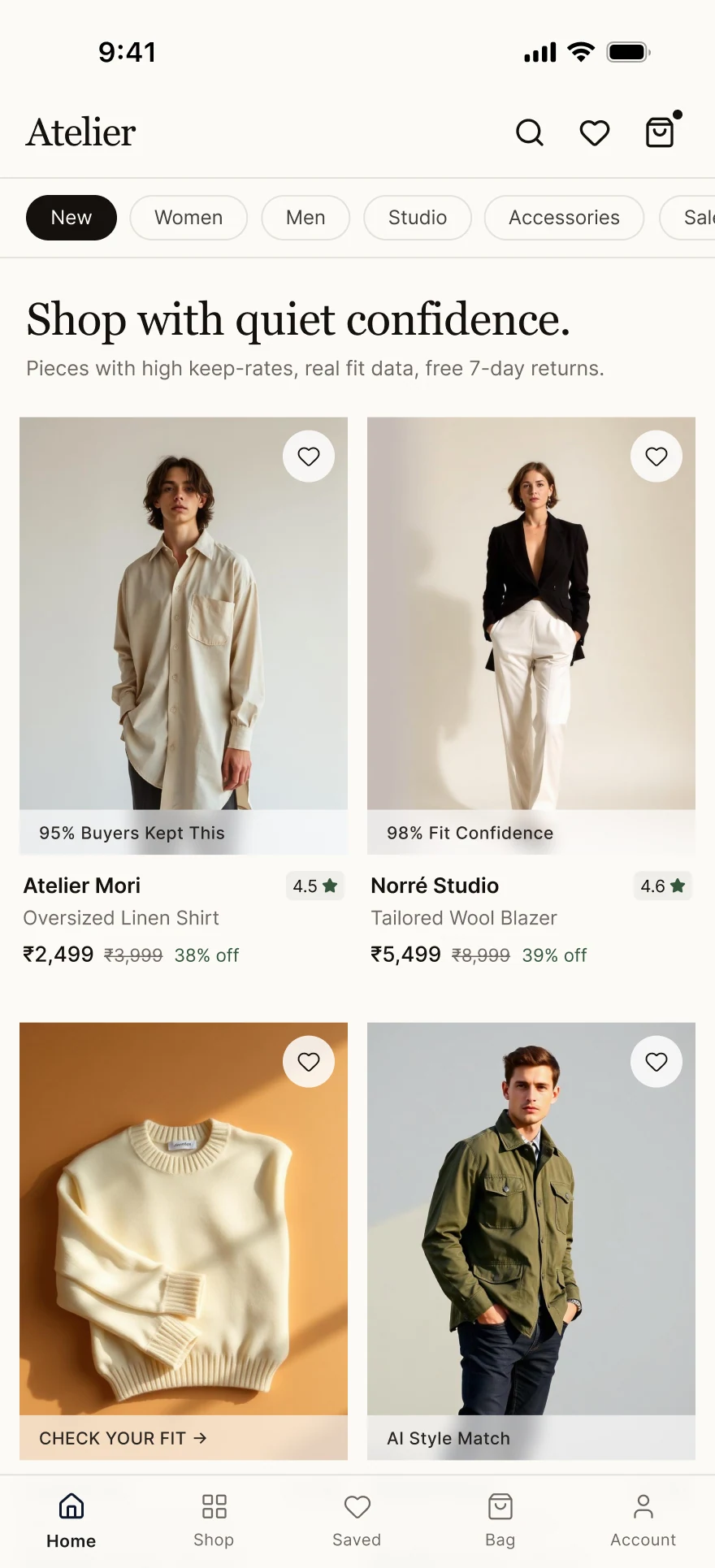
Developed and validated within a focused 14-day sprint.
Fashion commerce optimizes for urgency.
Observation
Speed sells the click. It rarely sells the belief that follows it.
Current experiences rely on
- Countdown pressure
- Scarcity
- Discount anxiety
- Impulsive decisions
Leading to
- Hesitation
- Sizing anxiety
- Low trust
- Post-purchase regret
“Users don't need more pressure. They need more confidence.”
A concept product grounded in behavioral research.
This is a concept case study exploring confidence-first commerce, not a redesign of an existing platform. Without access to production analytics, decisions were shaped by behavioral UX research and validated through moderated usability testing.
Scope
Concept product exploration
Behavioral UX as the primary lens
Moderated usability as validation
Key assumptions
Direct production analytics unavailable
Assumptions tested through user sessions
Objective: confidence-first, not urgency-first
Understanding why fashion purchases feel stressful.
Before exploring solutions, I wanted to understand what creates hesitation and anxiety during fashion purchases.
Research activities
One participant, one clear signal.
A representative synthesis from the research, showing how a single participant's perspective translated directly into design decisions.
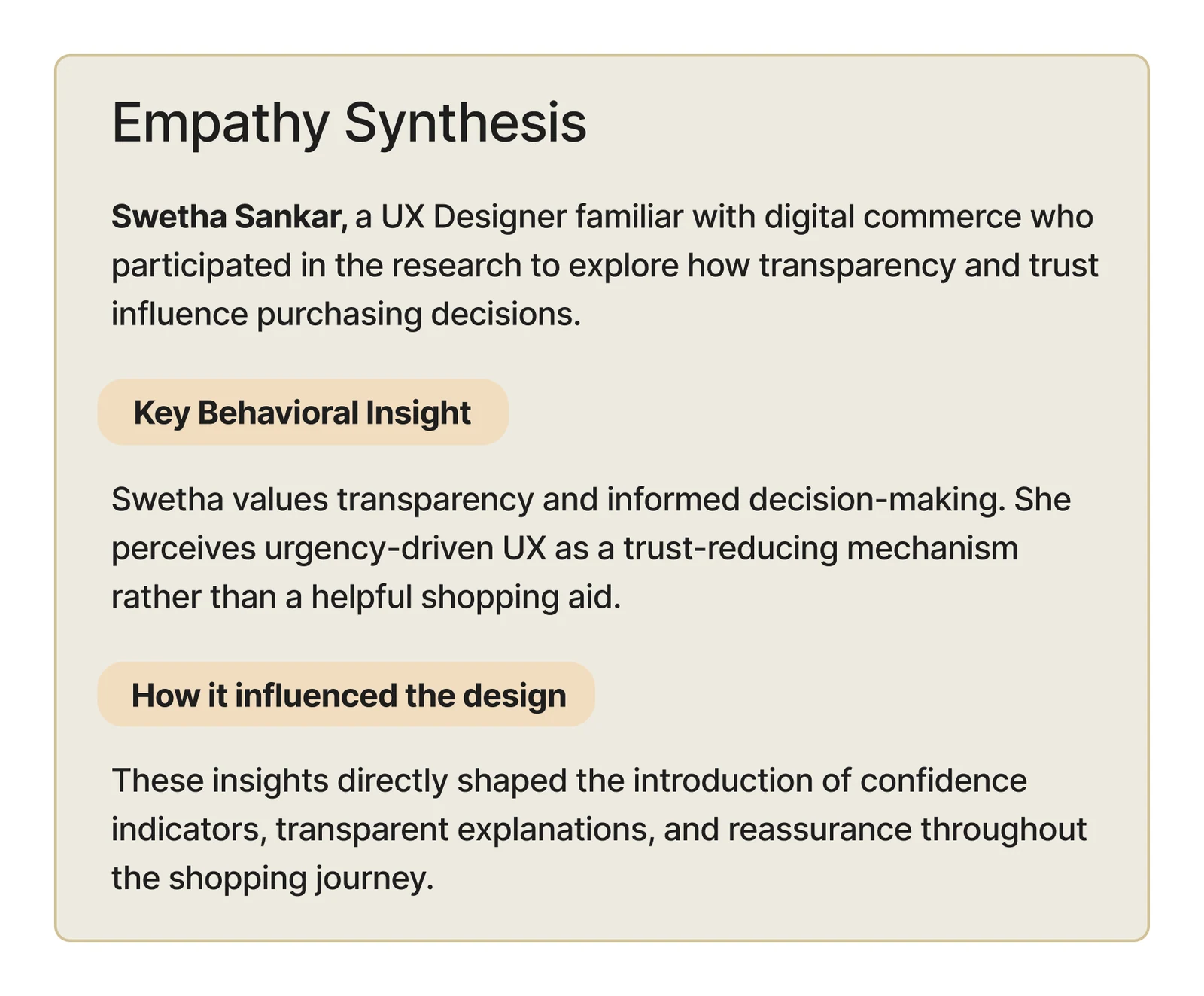
Research artifact — Empathy map supporting the synthesis presented above.
Working within
real constraints.
No access to live customer analytics.
Limited pool of moderated participants.
Time-boxed exploration across research and design.
Business impact estimated using behavioral research, not measured in production.
Pressure compounds into regret.
What users described
Each moment quietly borrows confidence from the next, until nothing is left at checkout.
Field note
“By the time I reach checkout, I'm already wondering if I should cancel.”
Repeat shopper, moderated session
Confidence can become a stronger conversion strategy than pressure.
From urgency to confidence.
Traditional fashion commerce
- Countdown timers
- Low stock pressure
- Information overload
- Fear-driven decisions
- Post-purchase regret
Confidence-centered commerce
- Trust indicators
- Fit confidence
- Digestible reviews
- Return transparency
- Calm decisions
A calmer path from browse to buy.
Scroll to follow how confidence is built across four moments, from the first glance to the final tap.
Four moments
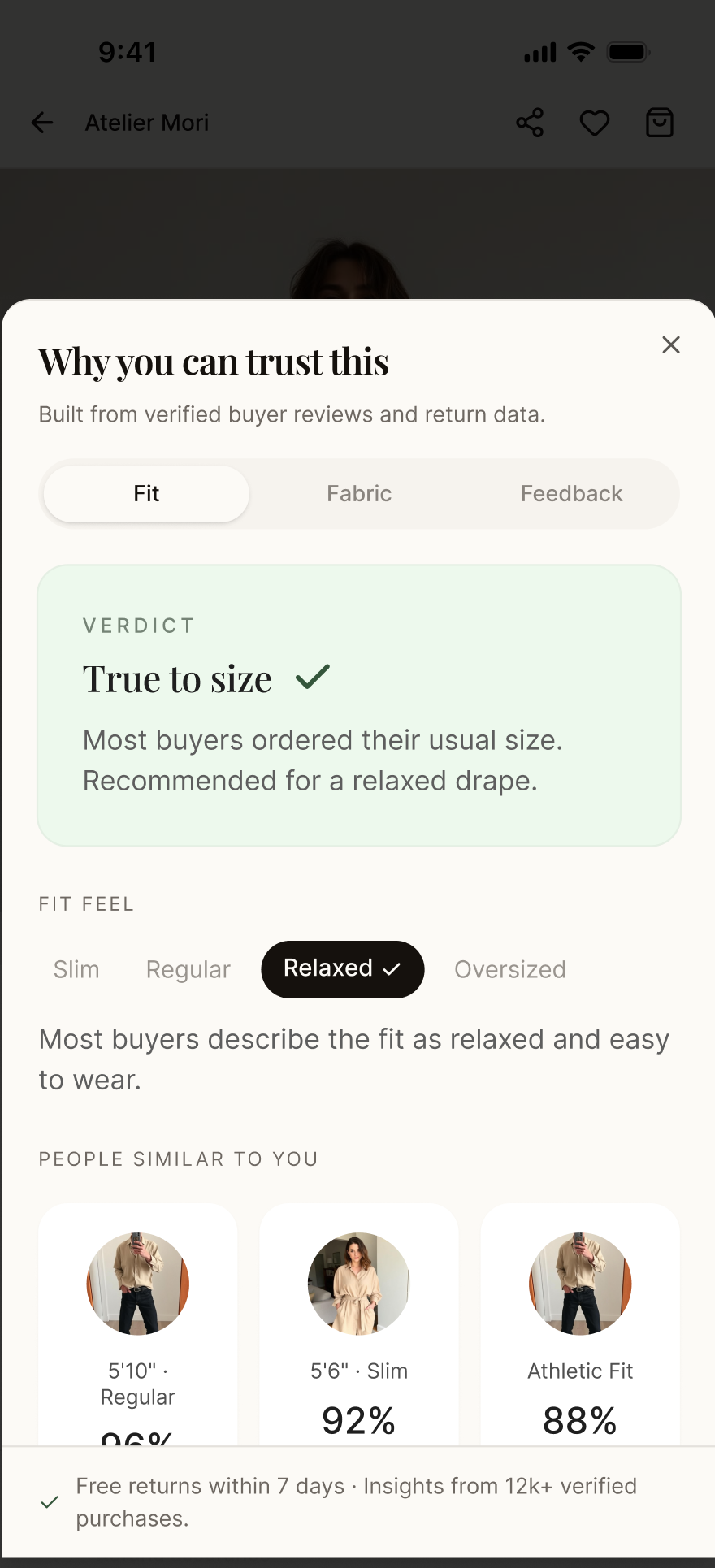
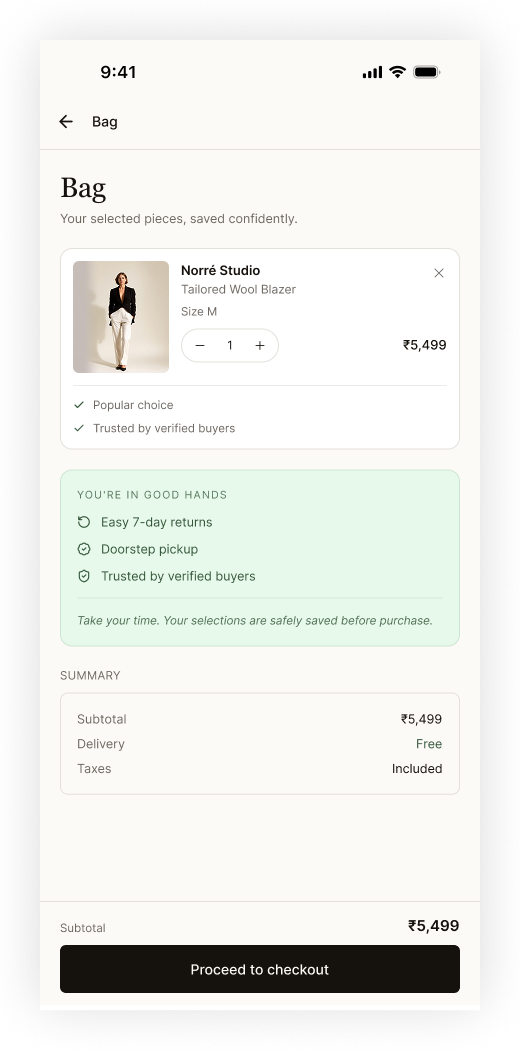
Discover, Evaluate, Understand, Purchase, each designed to return a small piece of trust.
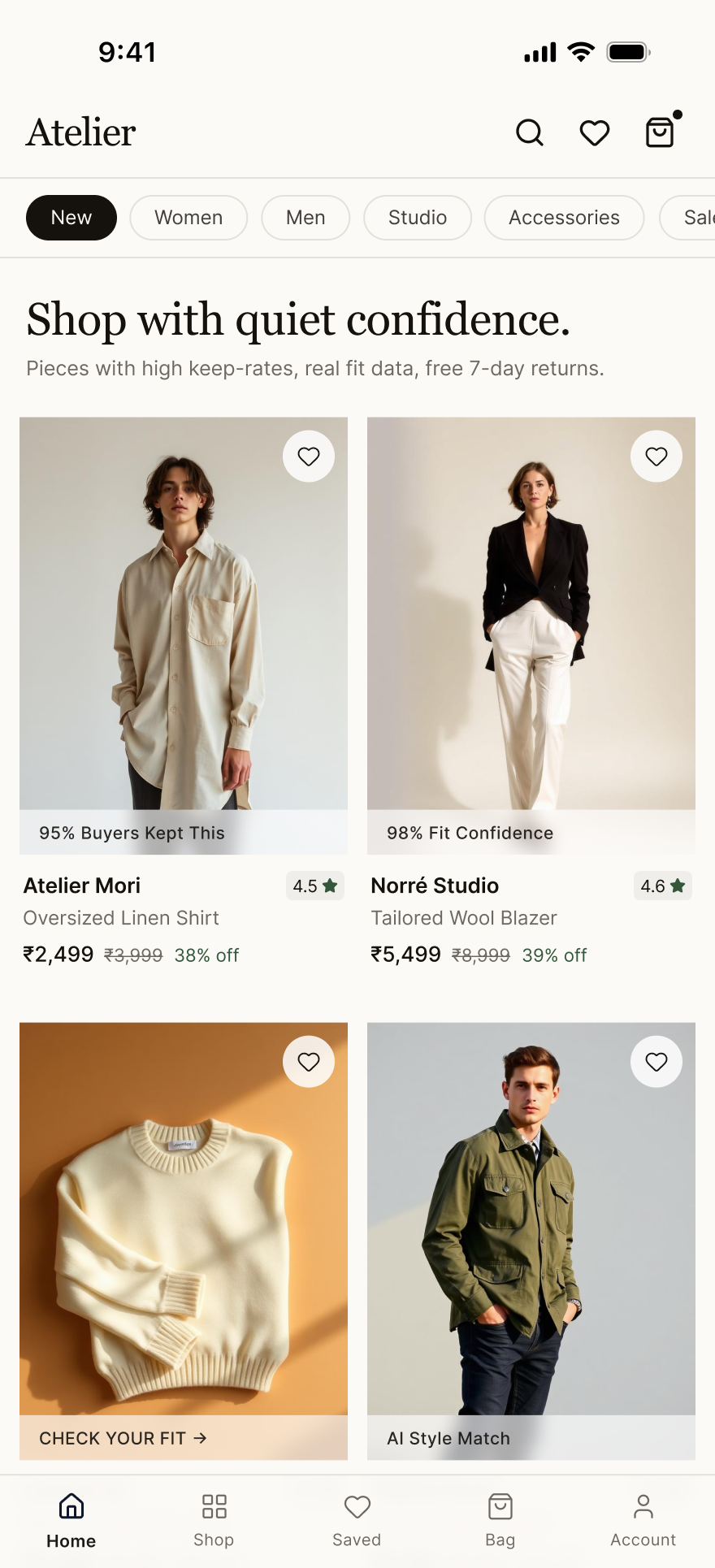
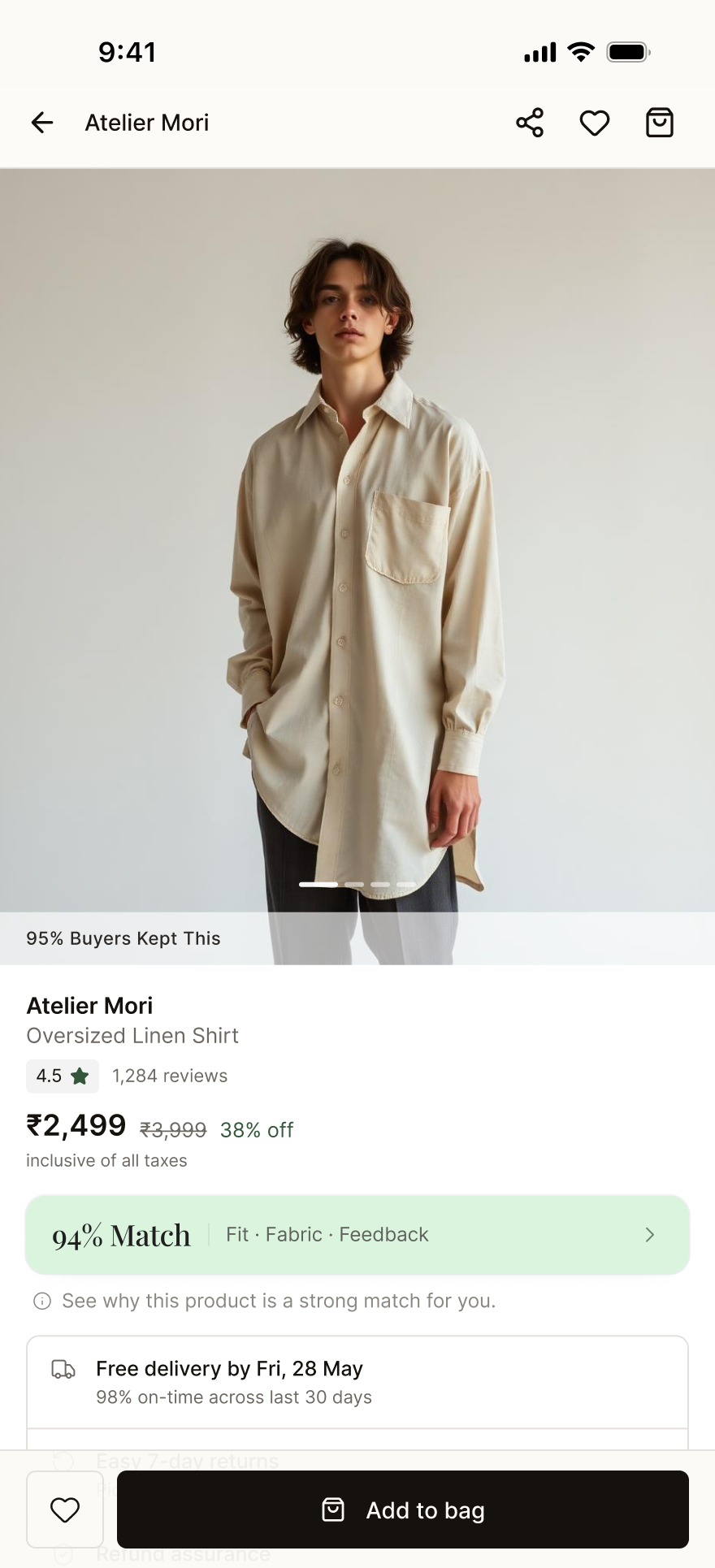
Discover
Users browse through reassurance instead of urgency.
Evaluate
Trust surfaces before hesitation.
Understand
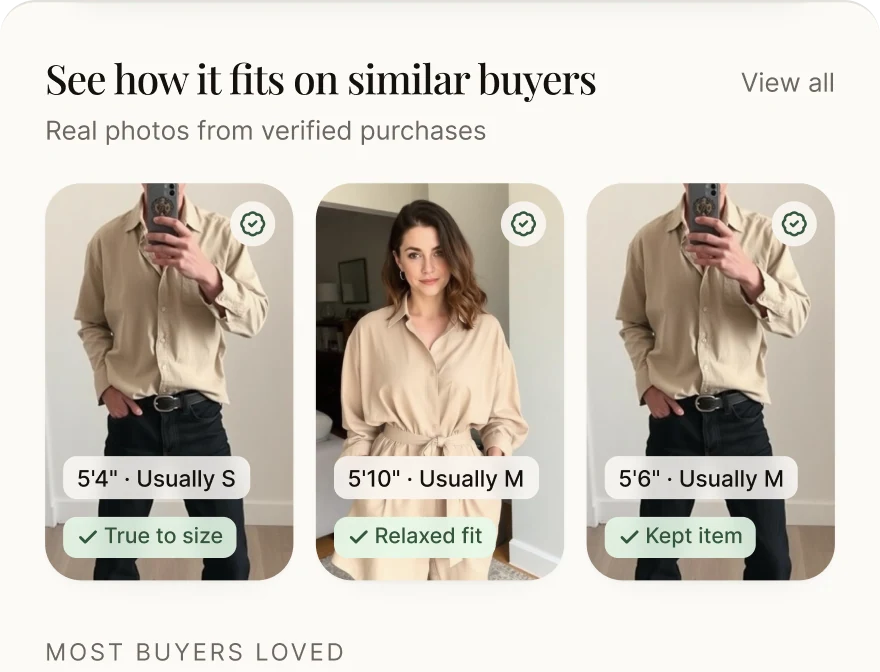
Reviews become digestible trust signals.
Purchase
Checkout becomes calm instead of stressful.
Why these decisions matter.
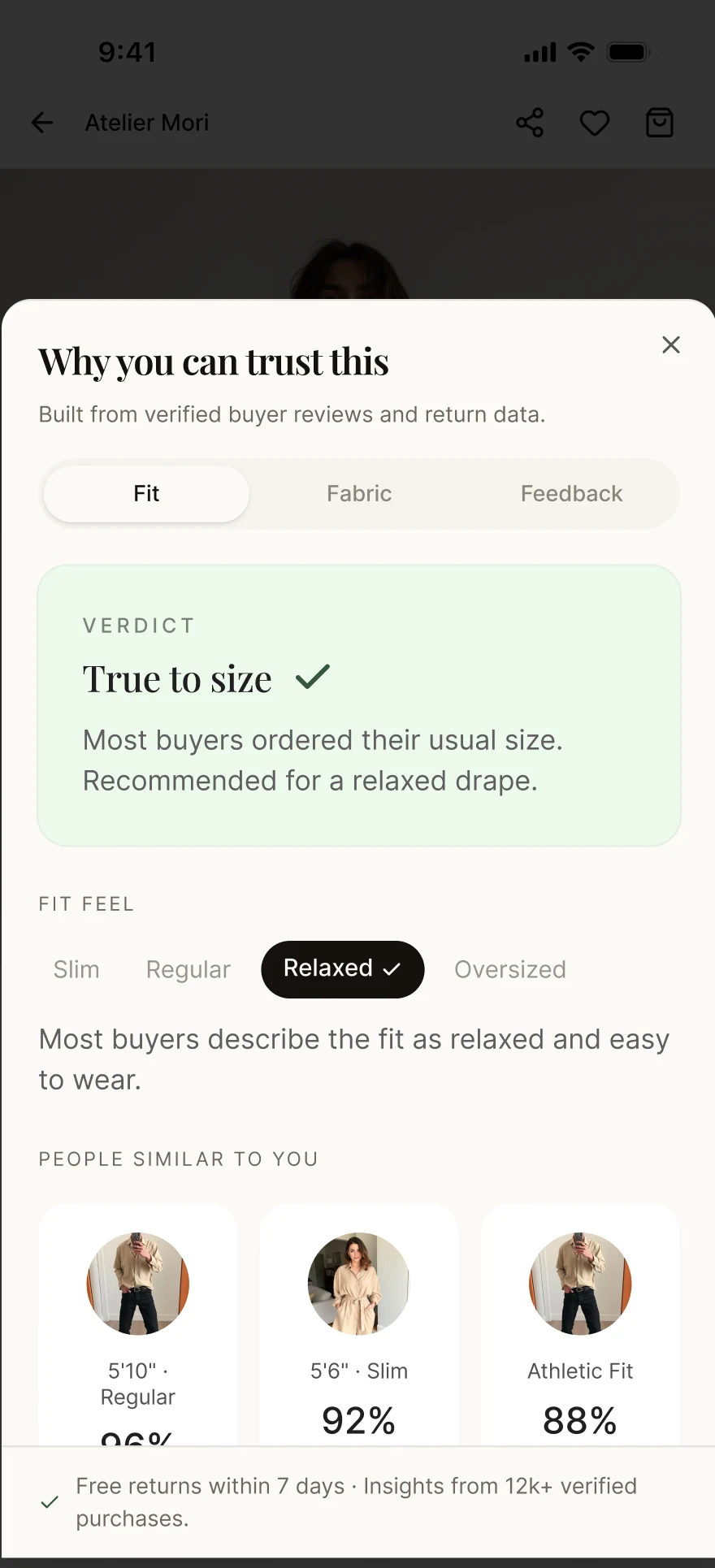
Every interaction was intentionally designed to reduce uncertainty and increase confidence.
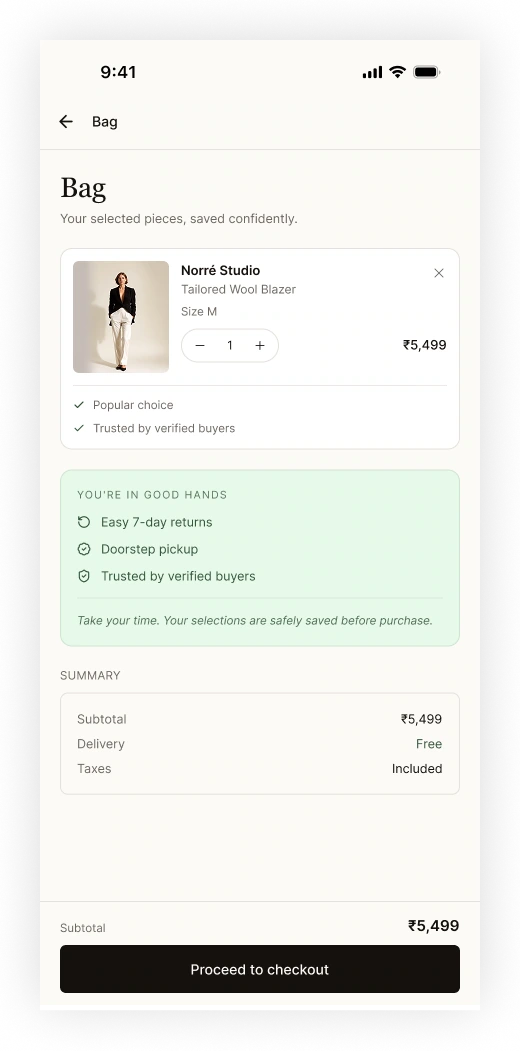
Experience the prototype.
Explore the interactive prototype and experience the confidence-first shopping journey firsthand.
First impressions
from real shoppers.
It actually feels like the app is on my side.
I stopped worrying about the size before adding to bag.
Everything felt calmer. I didn't feel rushed.
Testing the experience with users.
I ran moderated sessions using the interactive prototype and observed how people navigated the experience.
Participants
- Moderated usability sessions
Task scenarios completed
- Product discovery
- Trust evaluation
- Bag flow
- Checkout
Users compared familiar patterns with Myntra and Ajio
- Validating existing mental models
Users appreciated the calmer experience
- Reduced hesitation and improved trust
Participants preferred confidence indicators over generic ratings.
Users consistently found trust signals easier to understand than traditional star ratings.
Familiar Mental Models
Innovation that still felt familiar.
Users naturally compared patterns with established apps, validating that the experience balances innovation with familiarity.
“This feels less stressful.”
“I trust this more than star ratings.”
“The experience feels calmer and easier to understand.”
Listening, testing and refining.
The first version wasn't perfect. Feedback revealed opportunities to make the experience clearer and more intuitive.
Iteration 01
Improved comprehension.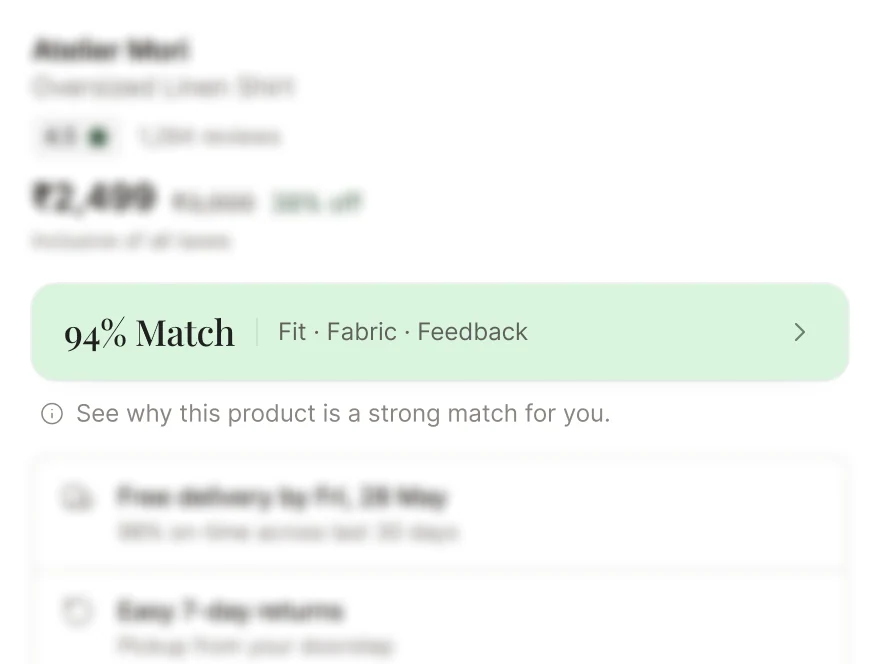
Iteration 02
Reduced confusion.Iteration 03
Aligned with familiar commerce patterns.Iteration 04
A more human, calming experience.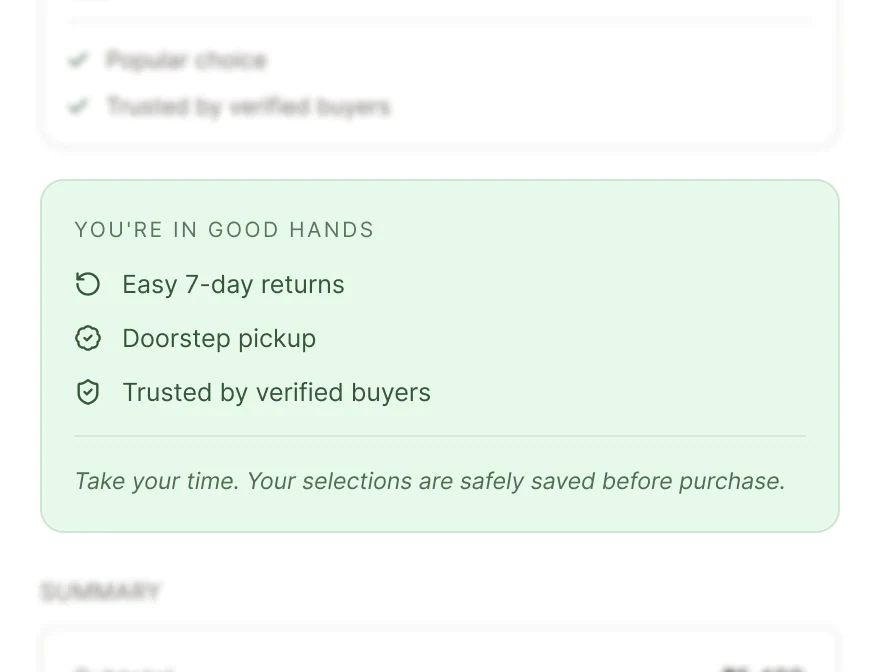
Revisiting the experience after iteration.
A follow-up round confirmed that the changes shaped by usability testing resolved the earlier friction points. Participants moved through the flow with less hesitation, understood the confidence signals faster, and reached checkout with visibly steadier decisions.
What earlier testing surfaced
- Confidence signals felt abstract
- Trust sheet was easy to miss
- Checkout still carried mild hesitation
What the revised flow addressed
- Signals read as concrete and human
- Trust surfaces became discoverable
- Checkout felt calm and reassuring
Calm decisions, better outcomes.
For Users
- Reduced hesitation
- Increased trust
- Calmer decisions
- Lower regret
For Business
- Better quality conversions
- Trust-driven loyalty
- Improved satisfaction
- Potentially lower return rates
Conceptual outcomes derived from behavioral UX principles.
Outcomes we would expect at scale.
These are projected outcomes, not measured production results, directional expectations grounded in the behavioral principles the experience is built on.
Reduced return rates
Increased purchase confidence
Higher checkout completion
Stronger long-term customer trust
Improved customer satisfaction
Directional outcomes derived from behavioral UX research, not production analytics.
How would success be measured?
If this concept went to production, these are the signals we would track to evaluate whether confidence-first commerce is actually working.
Return Rate
Signal of fit confidence and post-purchase satisfaction.
Checkout Completion
Signal of reduced hesitation across the funnel.
Purchase Confidence
Self-reported confidence at moment of purchase.
Customer Satisfaction
Post-delivery sentiment and NPS.
Repeat Purchase Rate
Long-term signal of durable trust.
Trust is not a feature.
Trust is infrastructure.
This project taught me that users don't always need more urgency or more features. Sometimes better decisions come from reducing anxiety and helping people feel informed. Confidence itself became the product.
Lessons learned
Behavioral design matters.
Trust deserves intentional design.
Iteration creates clarity.
Calm experiences outperform pressure.
Where the product could
evolve next.
Product directions that extend the confidence-first foundation beyond this concept, each one worth exploring as a distinct opportunity.
AI-powered size prediction
Personalized confidence scoring
Post-purchase confidence tracking
Confidence-driven recommendation engine
A/B testing confidence-first flows against urgency-driven flows
Trust can become the new growth strategy for fashion commerce.
By redesigning shopping around confidence instead of pressure, we improve both user experience and long-term business value.
Every project tells a different product story. Continue exploring.
PayNora
A confidence-first payment experience for senior citizens, shaped by behavioral research and inclusive interaction design.
Shinewoods Platform
Simplifying talent discovery through a scalable platform for talents, recruiters, and agents.
Suresh Babu
Senior UI/UX Designer
Crafted with clarity and intention.